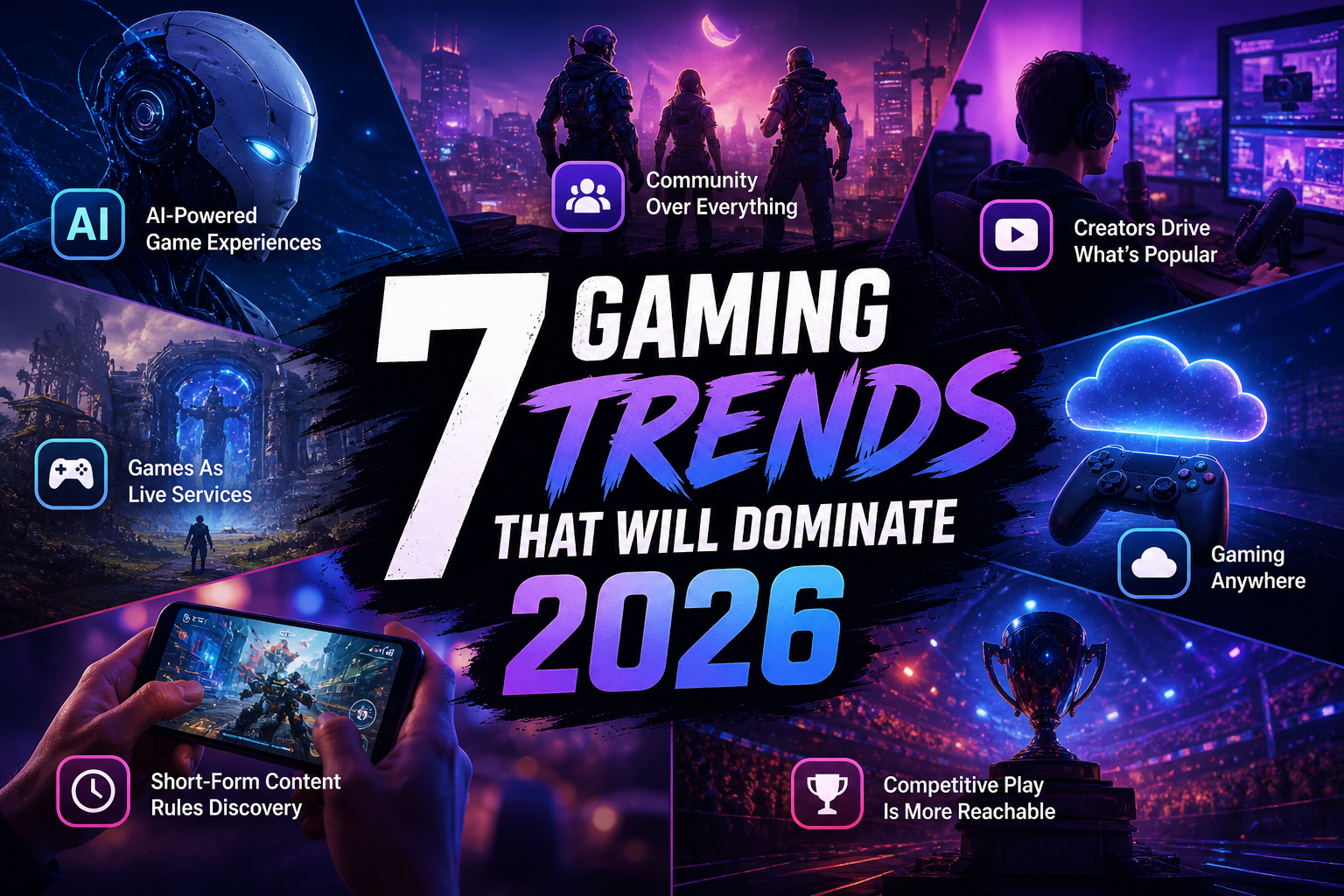
A grounded, insider look at the biggest gaming trends shaping 2026—breaking down how shifts like AI, short-form content, and creator-driven ecosystems are changing the way people play, watch, and get discovered in gaming.
The Gaming Industry isn’t just evolving, it’s moving faster than most people can process the trends as they occur. A decade ago (yes, around 2016), trends had time to settle. You could watch something grow, understand it, and then decide how to react. Now, things spike and dissipate before they fully make sense and get well ingrained into the fabric of public opinion.
And somewhere in the middle of all that, gamers are trying to figure out:
What to play
What to create
What’s actually worth paying attention to
As Gaming isn’t just about playing anymore. It’s where people hang out, build audiences, and spend a huge chunk of their time and money.
So, with this list, we provide a more honest breakdown of what’s changing and where you can leverage it as it happens.
1. AI is Starting to Change How Games Feel
For the longest time, game AI followed set patterns. You’d figure it out, adapt, and eventually it stopped being surprising. That’s beginning to shift.
Some newer games, such as GTA VI, are being built in ways that feel less scripted. NPCs react, not respond. Systems respond differently depending on how you play, what you play, when you play.
There’s also a quieter shift happening outside the game itself. AI is integrating into the content creation aspect with almost zero resistance—whether it’s via speeding up edits, feedback tests for ideas, or just getting unstuck. You have:
Claude 3 for advanced reasoning of your ideas and questions
NotebookLM for personalized document learning
HeyGen for video; Midjourney for imaging
The options will become endless!
If you’re trying to get started as a creator this year, this is probably one of the few areas where you can save a lot of time early without needing to be “great” at everything yet.
2. Platform does not Matter as Much as it Used to
There was a time when the first question was always: “What do you play on?” Now it’s “Can we all just play together?”
Multiple games of 2026 are highlighting cross-platform functionality, Forza Horizon 6, Diablo IV, Subnautica 2 etc., showcasing that companies understand people are not restricted to platform and usually have something that works—exactly the way Glitchover supports multiple platform access for creators to allow flexibility for their fans to join.
For anyone creating content, this changes things more than it seems. You’re no longer speaking to separate groups—you’re speaking to one combined audience that may have come from separate ways but together nonetheless.
3. Games Don’t Go Viral—People Make Them Viral
Since the glorious days of Pewdiepie, Markiplier, Ninja, and more such legends of streaming industry, it is evident that a game, seemingly comes out of nowhere, and suddenly everyone’s playing it.
But if you look closely, it almost always starts the same way: someone picks it up, clips start circulating, and it spreads from there.
Platforms like YouTube and Twitch are still where most of that happens, but it’s not just about where—it’s about who.
People don’t just watch anymore. They follow behavior. If someone they watch keeps coming back to a game, chances are they’ll at least try it. This was seen during the Chess boom of the 2020 Pandemic, albeit Queen’s Gambit started it, Chess Masters and social media personalities exploded the online chess traffic with their crazy tactics, or hilarious blunders.
Just know, as a consumer, this is where things get interesting. You possess the massive reach to influence something, for example spamming #useglitchover in your watched chats to pull your favorite creators into a match with your favorite game.
4. Don’t be Sloppy with the Seconds
There was a time when people discovered games through trailers, reviews, or full-length gameplay videos. That’s not how it works anymore.
Now, it’s a 10–15 second clip. Maybe less.
Something quick. Something chaotic. Something just interesting enough to make you stop scrolling. Platforms like TikTok, Instagram, and YouTube Shorts didn’t just change content—they changed attention spans. And once you get used to consuming games like that, it’s hard to go back.
You’ve probably seen it happen without realizing it. A random clip pops up in your YouTube Shorts, someone pulls off an insane 360 No-Scope, or fails in a way that’s just funny enough—and suddenly you’re looking up the game five minutes later.
It’s not planned. It just… happens.
That’s the way now. Games aren’t discovered in depth anymore. They’re discovered in moments and those moments, they just need to hit.
Just know, if you’re trying to get noticed, this is where things get uncomfortable because short-form doesn’t reward effort the way long-form does. You can spend hours making something—and it gets ignored. Or you post something simple, raw, and accidental and that’s what takes off.
Not perfect. Not overproduced. Just fast enough to stay in the loop. As right now, the difference between being seen and being invisible is often… just a few seconds.
5. Competitive Gaming Feels More Reachable
There was a time when high-level e-sports felt like a closed bubble. You either went through the system of teams, scrims, ladders, or you didn’t get in at all. Most people just watched from the outside, other than how it was perceived anyways.
That void is almost completely gone! Now you’ll see clips of unknown players showing up, holding their own against top-level competition, and suddenly people start asking: “Wait, who is this?”
It’s not as rare as it used to be because the path isn’t just structured leagues anymore, rather it’s the visibility.
Ranked ladders still matter, no doubt about it. Mechanics still matter. But moments matter just as much now. One good performance, one unexpected matchup, one clip that gets picked up—and things can shift quickly. You’ve probably seen it happen. Someone pulls off something clean against a known name, chat reacts, clips start circulating, and suddenly that player isn’t unknown anymore.
That’s the difference.
It’s not that e-sports has become easier. It’s that getting noticed has become more fluid and in that environment, you don’t always need a perfect resume. You need a moment that proves you belong. That’s also why playing against creators has started to mean more than it used to.
It’s not just about the game but about being seen in the right context. Holding your own in a match that people are already watching does something that solo grinding never really could do.
Players at GlitchOver are starting to lean into that idea, where you’re not just watching high-level play, you’re part of it. And if you perform, people notice, in the sense that the gap between “unknown” and “noticed” isn’t as impossible as it once felt.
6. You Don’t Need the “Perfect Setup” Anymore
For the long time Youtube vlogging fans, you may remember the setup vlogs and the checklists. Thus came the personal comparisons—better PCs, better mics, better internet. Better everything. It felt like you were already behind before you even started.
However, things are nowhere near the way they used to be.
Games are getting more accessible. Regularly priced devices are more capable. And with things like cloud gaming (example, GeForce NOW) slowly improving, the barrier to entry isn’t as rigid as it used to be.
You’ll still notice the difference at higher levels, of course. But getting started to create content? That’s no longer the hardest part. You’ve probably seen it yourself with people playing on basic setups (KSI, Pewdiepie again! Etc.), recording on whatever they have, and still managing to put out something that booms.
Because at some point, what you’re doing starts to matter more than what you’re using. And honestly, waiting for the “perfect setup” has quietly become one of the easiest ways to never start at all.
7. Gaming Is Where a Lot of Culture Is Happening
From following the culture, games now are shaping it.
You see it in small things like the memes shared, pop-culture references that only make sense if you’ve been in a certain lobby, watched a certain stream, and followed a particular channel. And then suddenly, those same moments start showing up everywhere else.
It’s not just the world OF games, it’s now The World IN games.
A good example of this shift was the Travis Scott Fortnite Concert. It wasn’t just a concert—it was something millions of players experienced live, inside a game world, at the same time. If you were there, you remember it differently than someone who just watched the clips later. Live events, unexpected collaborations, entire conversations that only exist if you were there at the right time. Miss it, and you’re catching up through clips like everyone else.
That shift is easy to overlook, but it changes how people engage where you’re not just playing something, rather you’re part of something that’s happening in real time.
Gaming isn’t sitting with entertainment anymore but living it, and reshaping it.
Final Thoughts
If you step back and look at all of this together, the pattern is pretty clear. Gaming is opening up to more ways to play and get noticed. It’s not just choosing what to play anymore. It’s deciding what to pay attention to, what to try, what to ignore. Blink and you’ll miss it at times. Creators who seem ahead most of the time aren’t necessarily the best or the most experienced. They’re just the ones who pick up on shifts a little earlier and act on them before they feel obvious. They start early, experiment, include their public, and by the time everyone else notices, they’re already established.
That gap isn’t as big as it used to be. Not because the space is less competitive—but because the entry points are more visible now. Sometimes it’s as simple as being in the right match, at the right time, with the right people watching. That overlap between players, creators, and audiences at Glitchover is starting to matter more than most people realize. If you’re in this space as a gamer or a creator, the opportunity is massive only if you evolve with it.