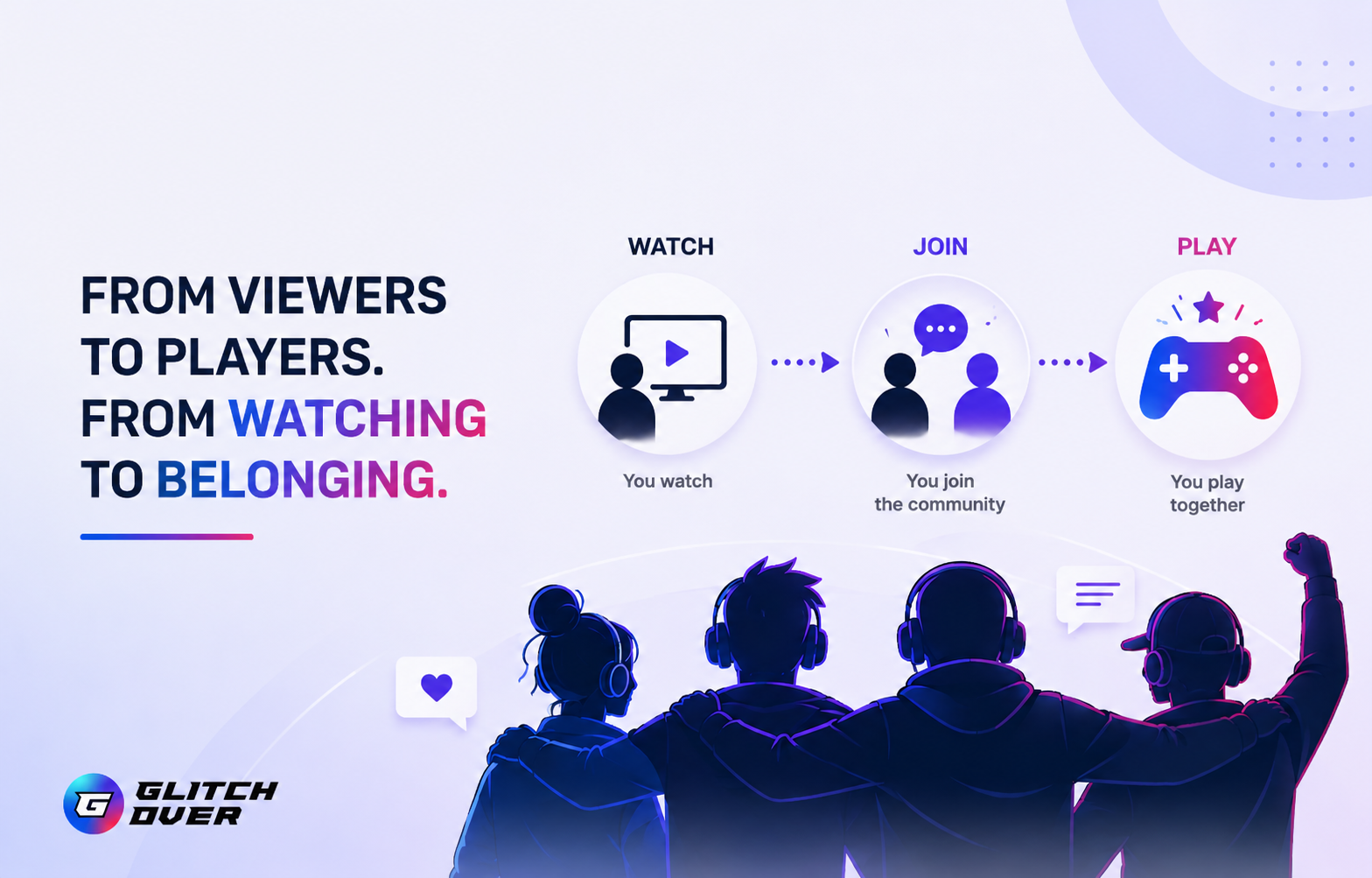
For years, the relationship between a gaming creator and their audience was straightforward: You play. They watch. What happens when your viewers stop being spectators and start becoming players?
Watching Is Easy. Participating Is Different.
Imagine two people discovering the same streamer. The first watches for an hour, enjoys the gameplay, laughs at a few moments, and leaves. The second watches for an hour, joins a community game, ends up playing on the creator's team, meets other viewers, and becomes part of a memorable moment on stream.
Both are viewers, but only one has actually experienced the community.
That's the difference between audience engagement and audience participation. A comment can create interaction, create a memory, and memories are often what make people come back.
Why Co-Play With Your Viewers Matters...
For growing creators, community is one of the hardest things to build. Getting someone to click on a video is one challenge. Getting them to return every week is another. Giving them a reason to feel like they belong can be even more powerful. Playing with viewers can help create that feeling because it changes the relationship between creator and audience.
Instead of:
Creator → Audience
it becomes:
Creator ↔ Community
They might be thinking:
“That's the game I played with the streamer.”
“That's the guy I met in the community lobby.”
“I want to be there when they do this again.”
That shift can turn passive viewers into active community members building your numbers with concrete proof of relevancy.
The Problem: Playing With Viewers Doesn't Scale Easily
There's just one problem.
Playing with five viewers sounds easy. Playing with fifty is harder. Playing with hundreds can become a full-time administrative job.
The moment a creator announces a community game, the questions start appearing:
Who gets a slot?
Who joined first?
What happens if someone doesn't show up?
How do you rotate players?
How do you share lobby information?
How do you stop the same few people from getting every opportunity?
And when the creator is streaming across multiple platforms, the process can become even more fragmented.
Discord messages.
Chat requests.
DMs.
Google Forms.
Spreadsheets.
Manual payments.
Private lobby codes.
Suddenly, the creator is spending more time organizing the game than playing the game.
That's the real barrier to community gaming.
Coordination then becomes the name of the game.
Community Gaming Needs Infrastructure to Sustain
Another interesting question how can the creators do it consistently. A creator should be able to say:
Saturday — 8 PM
Game — Valorant
Players — 10
…and let their community take it from there.
Viewers book their spot, join the queue.
The creator sees who is playing. Players get the information they need and when one session ends, the next one can begin. The less manual coordination involved, the easier it becomes for creators to make community gaming part of their regular content strategy.
That's where platforms like GlitchOver.com become useful.
GlitchOver is designed to help creators manage gaming sessions with their communities — from scheduled sessions and fan bookings to live queues and player coordination.
The idea is simple:
Let creators focus on the game. Let the system handle the logistics.
Playing With Viewers Can Become Content
There's another reason this matters. Community gaming doesn't have to be something that happens outside your content. It can become The Content.
Some content ideas for you streamers like:
“Beat the Streamer”
Your community gets a chance to take you down. Every week, new viewers compete for a place in the lobby.
“Community Tournament Night”
Instead of simply streaming another ranked session, you create an event your audience can participate in.
“Viewer Squad”
Fans get selected to form a team and take on another creator or community.
“Open Queue Friday”
Anyone can join the queue and potentially end up playing on stream.
These formats give viewers something to look forward to beyond your next stream.
More importantly, they create recurring moments that people can talk about, clip, share, and return for.
One Session Can Create More Than One Piece of Content
A community game can also become part of a larger content flywheel.
Community session
↓
Livestream
↓
Funny moments and highlights
↓
Short-form clips
↓
Social media posts
↓
New viewers discover the creator
↓
New viewers join the community
↓
More players for the next session
Instead of treating community building and content creation as two separate activities, creators can make them work together. The community generates experiences and Those experiences generate content that brings more people into the community.
The Future Isn't Just “Watch Me Play”
The most successful gaming communities aren't necessarily built around the biggest creators. They're built around creators who make their audiences feel involved. The difference can be as simple as changing the invitation.
Instead of:
“Come watch me play.”
It becomes:
“Come play with us.”
That's the opportunity community gaming creates.
And with the right tools, turning that opportunity into a repeatable part of your content strategy doesn't have to mean managing endless DMs, spreadsheets, and chat messages.
Your viewers are already watching.
Give them a way to join. Start building your community with GlitchOver.com